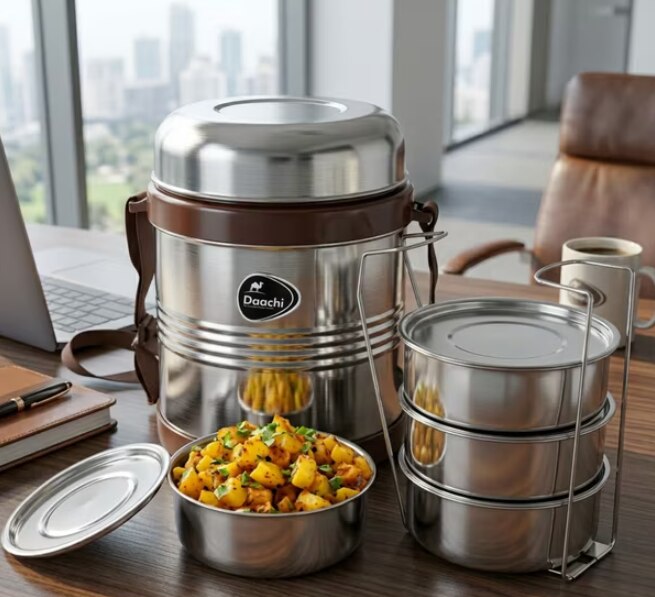
A 350 ml label does not tell you the box’s outside measurements, usable food volume, included parts, or ability to carry liquid without leaking. Use the specifications and checks below to compare suppliers, confirm bag and shelf fit, and decide whether the container suits your intended portion and food.
Key takeaways
- Allow 280–320 ml for practical filling, not the full 350 ml brim capacity.
- Check the gasket, lid fit and leak test before approving a box.
- Ask Delhi suppliers for steel grade, dimensions, batch details and food-contact documents.
- Fill below the rim, close evenly, wash the gasket and dry every part.
What 350 ml Means for Portions and Physical Size
A 350 ml box holds 350 cubic centimetres, or about 1.5 cups, only when filled to the brim. In use, leave headspace for the lid, so the practical fill may be closer to 280–320 ml.
That suits one small serving of rice, dal, sabzi, fruit, chutney or snacks; it is not automatically enough for a complete adult meal. Ask whether the stated capacity is brim capacity or recommended usable capacity.
- Request the external length, width or diameter, and total height with the lid fitted. These figures determine whether the box fits your handbag, school bag, office drawer or refrigerator shelf.
- Measure the base footprint and the lid’s widest point. A rounded lid can need more clearance than the container base suggests.
- Obtain the usable internal length, width, depth and fill-line height. Compare these with the actual food portion you plan to pack.
- Ask for the empty weight, lid height and space required when the lid is attached. Weight matters in a child’s bag, while attached-lid clearance matters in stacked storage.
The phrase “350 ml hut tiffin lunch box for details in delhi” does not identify a standard size or construction. Ask for hut tiffin lunch box specifications showing external dimensions, usable capacity, wall construction and net weight, then request a sample for measurement.
Your quotation should also state GST treatment, Delhi delivery area, minimum order quantity, damaged-unit replacement terms, branding options and lead time.
What the Airtight Lunch Box Contents Should Include
A 350 ml quotation must separate the container’s included parts from the food quantity it can hold. The airtight lunch box contents should include a stainless steel body, lid, continuous food-contact gasket, and the closure or clips that keep the gasket compressed. A snap-on lid alone does not prove an airtight seal.
Ask the supplier to identify each included item:
- Steel container, with grade and usable capacity
- Lid, including its plastic or steel material
- Gasket, with material and whether it is removable for washing
- Locking clips or threaded closure
- Spoon, carry pouch, divider, or separate compartments, if included
- Branding, insert, and packaging components that touch the food
Use this comparison to check food-contact suitability rather than relying on the words “hut tiffin” or “airtight”:
| Component | Details to request | What can go wrong |
|---|---|---|
| Steel body | Grade, such as 304 or 316, plus a food-contact declaration or test report | Unknown alloy, corrosion, or metallic taste |
| Gasket | Silicone or named elastomer, temperature range, and food-contact evidence | Odour, swelling, staining, or contamination |
| Plastic lid | Polymer name, food-contact evidence, and heat limit | Warping, cracking, or chemical transfer |
| Coating, adhesive or printing | Location, composition, and food-contact approval where it can touch food | Flaking ink or adhesive entering the food |
The supplier should state whether 350 ml means brim capacity or recommended fill capacity. A small portion of rice, dal, chutney, snacks, or fruit may fit, but the label does not make it a complete meal container.
How to Judge the Lid, Gasket and Leak Protection
A closure is suitable for dal, curry, sambar, oil and other liquid foods only when it combines a continuous food-contact gasket, even lid compression and a closure that holds that pressure during handling. A snap lid or tight-fitting lid alone does not prove an airtight or leakproof seal.
- Remove the lid and inspect the gasket. It must form one unbroken ring, sit fully inside its channel and have no cuts, gaps, flattening or loose corners.
- Refit the lid and press around its edge. The lid should contact the gasket evenly; a lifted corner or visibly wider gap identifies a likely leak path.
- Operate every clip, latch or screw closure. Each must close fully and keep the lid down without bending, loosening or releasing when you carry the filled box.
- Fill the container with water to the supplier’s stated practical fill line, close it, turn it upside down for at least five minutes and shake it gently. Check the rim, clips and base for droplets.
- Repeat the check with a hot-liquid test requested from the supplier. Ask for the test temperature, orientation, duration and pass/fail rule, because a container can restrict air exchange yet leak when inverted or filled hot.
Record the gasket material, closure type and leak-test method in the hut tiffin lunch box specifications. The airtight lunch box contents should identify these parts separately; “hut tiffin” is not a technical guarantee of insulation, airtightness or leak protection.
How to Fill, Close, Clean and Test a 350 ml Box
Fill only to the specified usable capacity, not the rim. Leave headspace for dal, curry or hot food to expand, and keep oil, sauce and grains off the sealing edge.
- Wash the body, lid and gasket with warm water and mild detergent. Remove the gasket if the design permits, clean its groove, and dry every part completely.
- Inspect the rim and gasket before filling. Reject a sample with a burr, cut, twist, loose fit or uneven gasket; these faults create a leak even when the lid feels tight.
- Place the gasket flat in its groove, align the lid without sliding it across food, and engage every clip or locking point evenly. Do not force a lid over a displaced gasket.
- Test a production-representative 350 ml stainless steel tiffin box in delhi with water first. Fill to the stated usable level, close it, invert it for 60 seconds, shake it gently, and check the rim and clips for droplets.
- Repeat with the intended hot or oily food, then let the closed box cool fully before opening it. Check whether pressure, staining or food trapped under the gasket has changed the seal.
- Run the same sample through the intended dishwasher or wash cycle, if applicable. Recheck the gasket, closure and rim after repeated washing, then measure the filled volume with a graduated jug; approve only if the usable capacity matches the specification.
What to Ask a Delhi Supplier Before You Buy
A low quoted price does not tell you whether 350 ml is brim capacity, usable capacity, or whether the unit will survive delivery. Ask for a production-representative sample before placing a bulk order, especially if you plan to buy stainless steel lunch box in Delhi for offices, schools, or gifting.
Request these details in writing:
- Body and lid stainless-steel grades, wall construction, gasket material, closure type, net weight, external diameter, height, base footprint, and usable internal dimensions.
- Capacity measured to the brim or practical fill line; require the usable volume in millilitres.
- Sample testing with water and the intended hot or oily food: invert, shake, cool, open, inspect the gasket, and repeat after the relevant wash or dishwasher cycle.
- GST treatment, delivery area, minimum order quantity, branding options, sample charges, lead time, and replacement terms for damaged or leaking units.
Aarav Enterprises should receive the same specification when you compare its quotation with another Delhi supplier; the product name alone proves none of these points.
Check the quotation against this comparison:
| Check | Acceptable confirmation | Clarify or reject |
|---|---|---|
| Capacity | 350 ml usable volume with fill-line method | “350 ml” without measurement basis |
| Insulation | Single-wall, double-wall air, or vacuum stated | “Insulated” without construction |
| Commercial terms | GST, MOQ, lead time, delivery and replacements stated | Verbal promises only |
| Sample result | No leak after testing and wash exposure | Sample differs from production model |
“Hut tiffin lunch box” is a shape or marketing term, not proof of insulation, airtightness, compartments, or leak protection. A supplier offering a 350 ml stainless steel tiffin box in Delhi should identify each property separately.
Related product
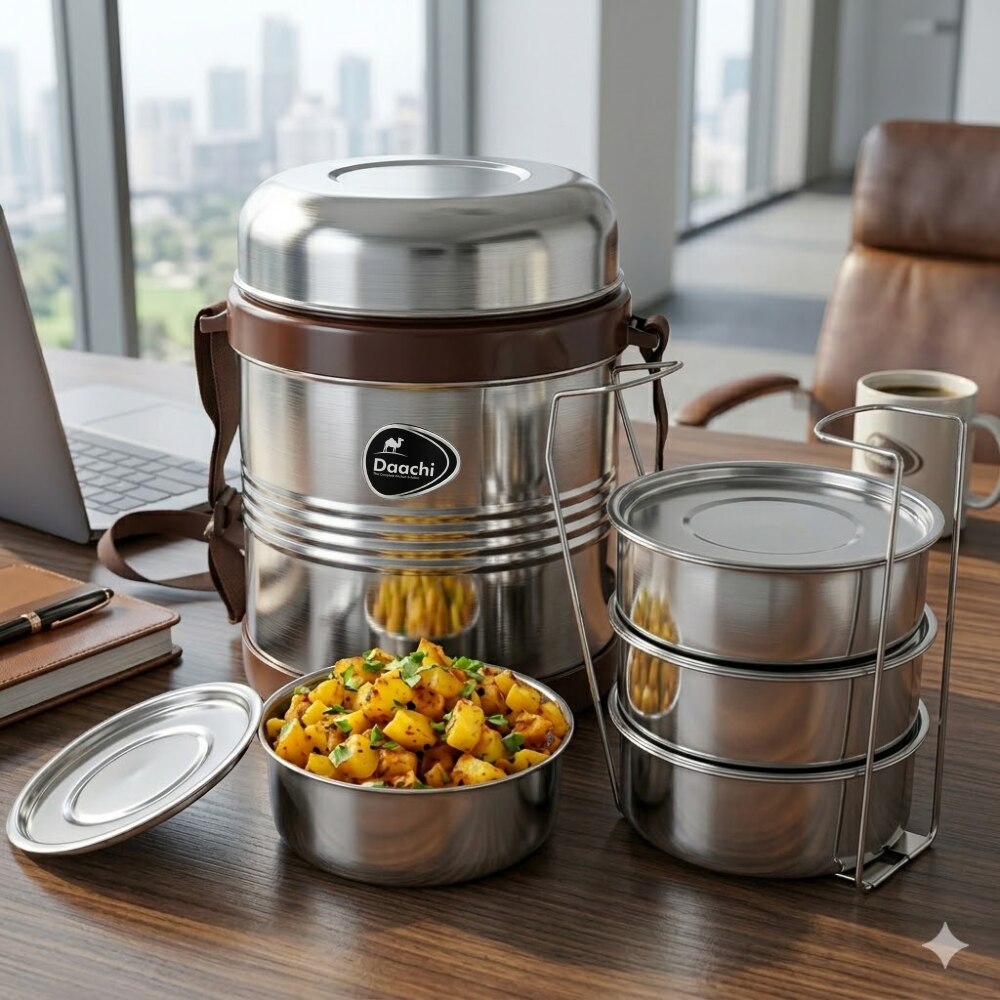 | Lunch Box 350 ml Hut Tiffin Stainless Steel Airtight Lunch Box ₹450 350 ml Hut Tiffin Stainless Steel Airtight Lunch Box The Daacchi 350 ml Hut Tiffin Stainless Steel Airtight Lunch Box is a perfect combination of... View product → |
Frequently asked questions
How much food fits in a 350 ml hut tiffin lunch box?
The box holds 350 cubic centimetres, or about 1.5 cups, at the brim. Leave headspace for the lid, so a practical fill is about 280–320 ml.
What should an airtight lunch box include?
Check for the stainless steel container, fitted lid, food-contact gasket and a closure that compresses the gasket evenly. Confirm the supplier’s stated dimensions and material grade.
How do you test a 350 ml lunch box for leaks?
Fill it with water below the rim, close the lid evenly, turn it upside down over a sink and check the lid edge for seepage. Repeat after washing and refitting the gasket.
What should you ask a Delhi supplier before buying?
Ask for the steel grade, internal and external dimensions, usable capacity, gasket material, leak-test method, minimum order quantity, packaging details and food-contact documentation.
Keywords