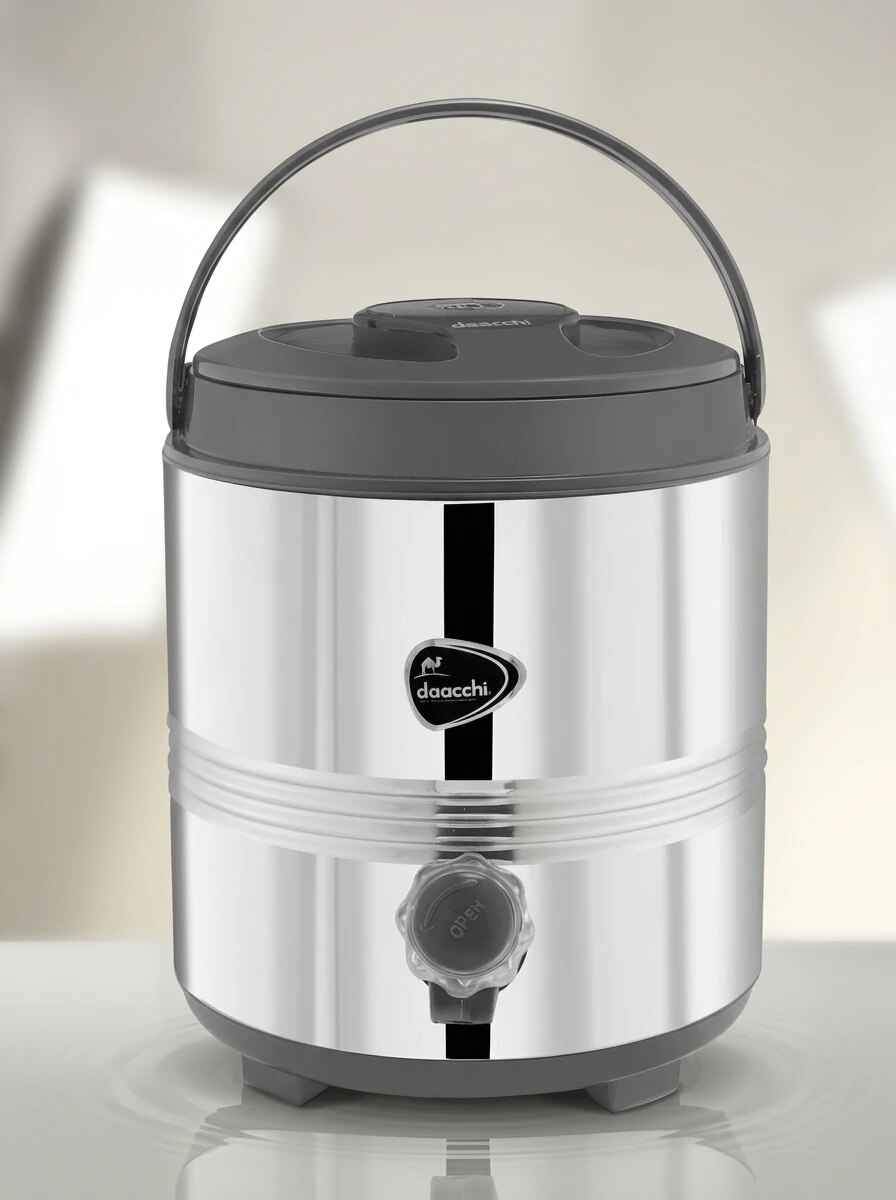
A 9.5-litre vessel can reduce refilling at one service point, but its full weight, footprint and single-unit failure risk change the decision. Compare usable capacity, serving demand, access points, lifting conditions and cleaning requirements before choosing one large jug or several smaller containers.
Key takeaways
- 9.5 litres equals 38 servings of 250ml before allowing for unusable water.
- Choose one large jug when a single station serves many people quickly.
- Use a trolley or two-person lift when the filled jug is difficult to control.
- Specify steel grade, insulation, tap position, lid and cleaning access before ordering.
How many servings does 9500ml provide compared with smaller containers?
One 9500ml jug provides a meaningful service advantage when one station serves many people, but its nominal capacity does not equal usable water. For the 9500ml water jug vs smaller containers in Delhi, the direct capacity comparison is:
| Container | Equivalent to one 9500ml jug | Practical implication |
|---|---|---|
| 500ml | 19 containers | More units to carry, chill and distribute |
| 1L | 9.5 containers | More frequent replacement at a service point |
| 2L | 4.75 containers | Easier rotation across rooms or tables |
| 5L | 1.9 containers | Fewer units without committing to one large vessel |
At 150ml per serving, 9500ml provides about 63 servings. At 200ml, it provides about 47; at 250ml, 38.
Those are theoretical counts before deducting headspace, ice, spillage and water left below a tap. Ask for the usable fill volume with the lid fitted and the manufacturer’s required headspace, because stated capacity often means brim capacity or internal capacity rather than the recommended working fill.
The large 9500ml stainless steel water jug reduces refills, handling and service interruptions. It also creates one point of failure: if the vessel is dirty, damaged or empty, the entire station stops. Smaller containers cost more in unit handling but are easier to rotate, chill, replace and distribute.
When is one large jug the better office choice?
A large jug is the better office choice when one service point consumes nearly its usable volume before the next refill. Calculate demand as people served × expected servings per person × serving size, then add meetings, visitors and peak-period use.
| Planning serving | Example demand | Capacity decision |
|---|---|---|
| 150ml | 40 users × 1 serving = 6L | 9.5L leaves working allowance |
| 200ml | 40 users × 1 serving = 8L | 9.5L fits one interval |
| 250ml | 40 users × 1 serving = 10L | Refill or use more capacity |
Match that result to the replenishment interval, not the advertised maximum volume. A 9500ml jug suits one meeting room, pantry or reception point that regularly consumes most of its usable volume before the next refill.
Use several 500ml to 2L containers for dispersed teams, multiple rooms or limited counters. Staff can stage and rotate them near users without moving a full load exceeding 10kg. One jug cannot serve several rooms simultaneously without a tap, stand or repeated pouring.
Use these four checks before choosing an insulated water jug in delhi:
- People served during each interval, including visitors and meetings.
- Litres consumed before the planned refill.
- Refill trips saved by centralising water.
- Counter area and safe space for the jug.
Choose 9.5 litres only when demand justifies it. Low use leaves water sitting for long periods, while smaller containers are easier to rotate, clean and replace.
Which format works during catering service?
Choose the 9500ml format when one buffet, meeting table or beverage station will consume most of its usable volume during the service window.
Calculate demand as guests × servings per guest × serving size, then divide by beverage stations: 60 guests taking two 200ml servings need 24 litres total, or 8 litres at each of three stations.
| Format | Best fit | Service trade-off |
|---|---|---|
| 9500ml | One busy, fixed station | Fewer refills and interruptions, but one failure stops that station |
| 5L | Separate stations or moderate demand | Easier carrying and rotation, with more refill handling |
| 2L | Crowded venues, refrigeration or rapid replacement | Highest mobility and resilience, but more containers to manage |
A single 9.5-litre jug cannot provide simultaneous access at several tables without a tap, stand or repeated pouring. Choose 2L or 5L units when staff must carry water through a crowded venue, replenish separate stations, move containers into refrigeration, or replace a contaminated or damaged unit quickly.
That is the practical balance in a 9500ml water jug vs smaller containers in Delhi comparison; a large water storage container in Delhi still needs a fixed, stable service point.
A bottom tap reduces lifting but adds seals, a narrow flow path and dead space. Flush or dismantle those parts during cleaning.
Use a defined rotation plan:
- Empty the vessel at the service interval; do not keep topping it up.
- Wash, rinse and dry the jug before refilling.
- Remove it from service immediately after damage, contamination or a leaking tap.
Can a full 9500ml jug be lifted, placed and used safely?
Water weighs about 9.5kg in a full 9500ml jug. After adding the stainless steel vessel, lid, handle and tap, the gross weight commonly exceeds 10kg, so treat it as a two-hand or fixed-station item rather than a casual one-hand server.
1. Ask the supplier for the overall height, maximum diameter, handle clearance, lid-opening clearance and tap-outlet height. These figures determine whether an insulated water jug in Delhi fits your site.
2. Measure the available gap under office taps and purifiers, inside refrigerator shelves and transport crates, and beneath serving tables and catering counters. Leave enough overhead space for the lid to open fully without striking a shelf.
3. Place the filled jug on a stable raised stand or counter that supports its complete footprint and more than 10kg of load. Keep it away from counter edges, unstable stools and walkways, and avoid repeated lifting from floor level.
4. Check that the tap leaves room for a glass and that its outlet does not drip onto the floor or block nearby equipment. A large water storage container in Delhi becomes a handling hazard when staff must lift it repeatedly or reach across a crowded counter.
Buy it for a fixed station when these measurements work; choose smaller containers when staff must carry, chill or distribute water between rooms and tables. A suitable footprint does not make a full vessel easy to move.
What should you specify before ordering a large water jug?
Put the contact-surface steel grade in the purchase specification, not just “stainless steel” or “food grade.”
| Grade | Resistance | Buying implication |
|---|---|---|
| 201 | Lower corrosion resistance | Avoid choosing it solely for a lower quote |
| 304 | Widely used for food-contact vessels | Suitable for ordinary drinking-water service |
| 316 | Greater resistance to chloride-containing water and cleaners | Consider it for aggressive water or cleaning conditions |
For a large water storage container in Delhi, request a material certificate or test report. Also specify a smooth, inspectable interior, finished welds, silicone gaskets, threaded caps and a tap that can be dismantled or cleaned properly.
For an insulated water jug in Delhi, reject an unsupported claim such as “keeps cold for 12 hours.” Require the test condition and end-point temperature, recording:
- Starting water temperature and ambient temperature
- Fill level and whether ice is used
- Lid-opening frequency and direct sunlight exposure
- Vacuum or foam insulation
- Sealed, push-button or continuously open closure
A loose stopper or open tap can lose more cooling performance than the insulation specification suggests.
Ask for scale-cleaning instructions based on the water supplied at your site. Mineral deposits collect around the base, tap and lid seal; abrasive pads and chloride-bearing cleaners can stain or damage stainless steel.
Aarav Enterprises becomes relevant when its quote confirms usable capacity, dimensions, grade, tap construction, cleaning procedure and test conditions. Choose the 9500ml stainless steel water jug only when those details match your station, demand and handling plan.
Related product
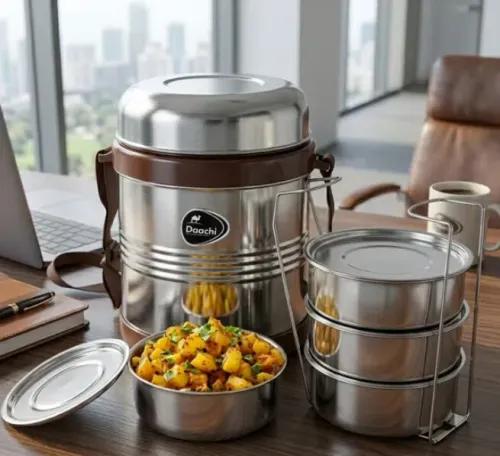
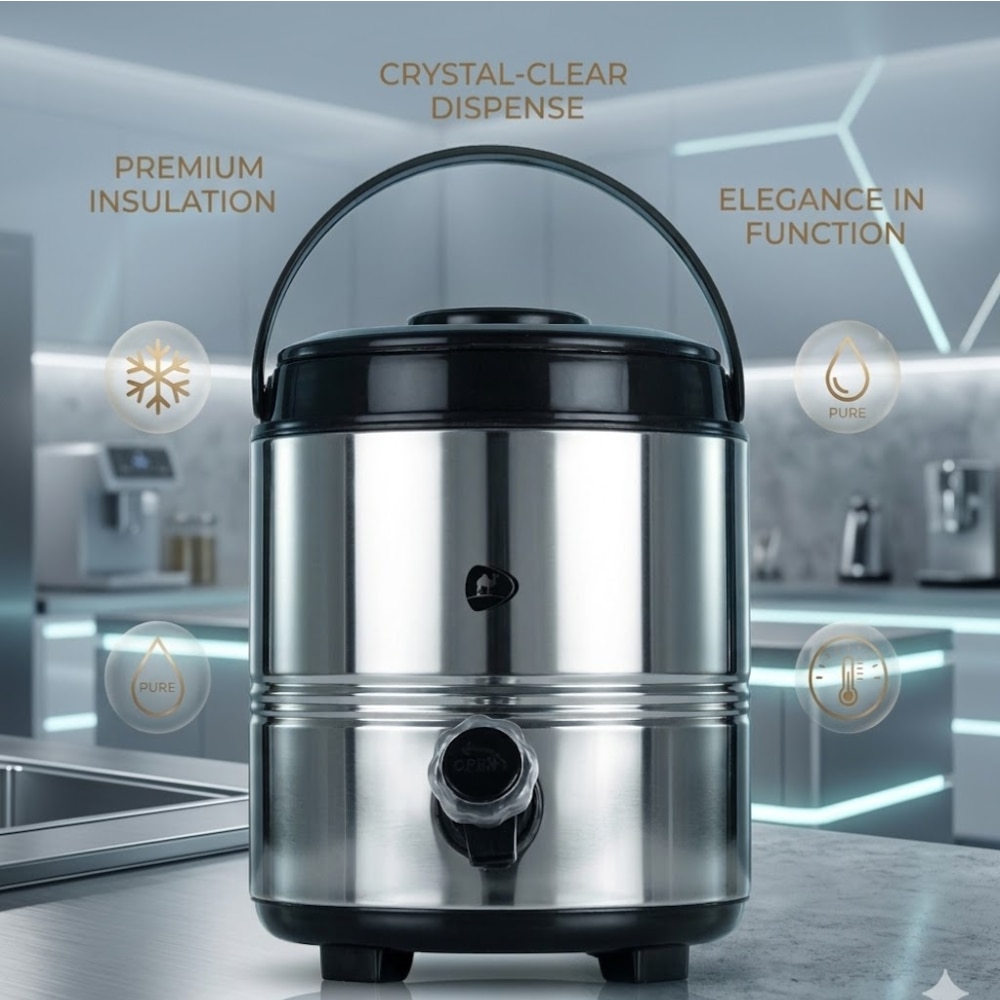 | Lunch Box Insulated Stainless Steel Water Jug (9500ml) Insulated Stainless Steel Water Jug (9500ml) The Daacchi Insulated Stainless Steel Water Jug (9500ml) is a premium-quality beverage storage solution... View product → |
Frequently asked questions
How many servings does a 9500ml water jug provide compared with smaller containers?
A 9500ml jug holds 38 portions of 250ml or 19 portions of 500ml by nominal capacity. Allow for headspace, spillage and water left below the outlet when estimating service quantity.
When is one large jug the better office choice?
Choose one large jug when a shared pantry, meeting room or reception station serves many people and you want fewer refills. Use smaller containers when departments are spread across floors or staff need portable portions.
Which format works during catering service?
A large jug suits a fixed beverage station with steady demand. Smaller containers work better for table service, short counters, frequent repositioning or menus that need separate water options.
Can a full 9500ml jug be lifted, placed and used safely?
Water alone weighs about 9.5kg, before adding the jug. Check the handle grip, base stability and tap clearance; use a trolley or two-person lift if one person cannot place it without twisting or losing control.
What should you specify before ordering a large water jug?
Confirm the stated capacity, stainless steel grade, insulation, lid design, outlet or tap height, handle construction, base diameter, cleaning access and whether the filled unit fits your dispenser or service counter.
Keywords